

This time, we have two reports!
Trip to The Guildhall Bury St Edmunds – a report from Clare.
August 2025.
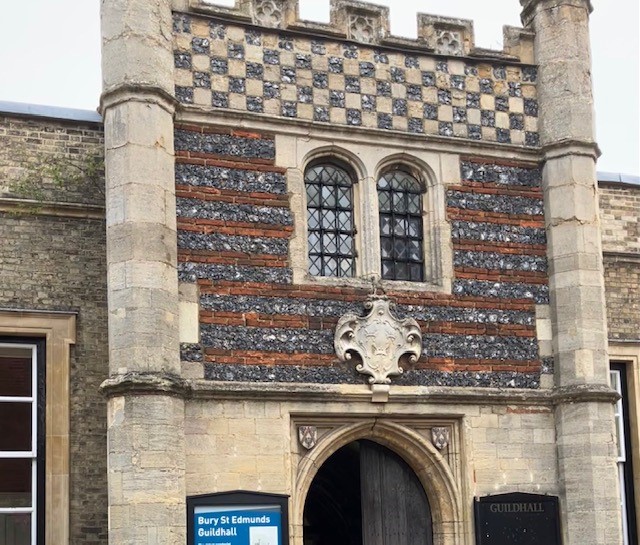
On a swelteringly hot August day, we all made our own way to meet up at the Guildhall in Bury St Edmunds. The Guildhall is the oldest provincial civic building in the country. It is an impressive, Grade 1 listed flint-stone building which has stood on the site since at least 1220. However, recent archaeological discoveries suggest the building is much older, possibly dating to the early 1100s. It was originally built with a thatched roof, which was replaced in 1785 by a leaded one but the lead was stolen in 1788 – nothing is new !
We had a very informative guided tour.
We learnt that the Guildhall was built for the local Guild of Merchants, the Townsmen’s Guild, a group who oversaw the business of the town. There was constant conflict between the town and the Abbey and during the town’s peasants’ revolt in the 1300s, when the town claimed that the Abbey owed them a lot of money, a group of monks were held hostage within the Guildhall.
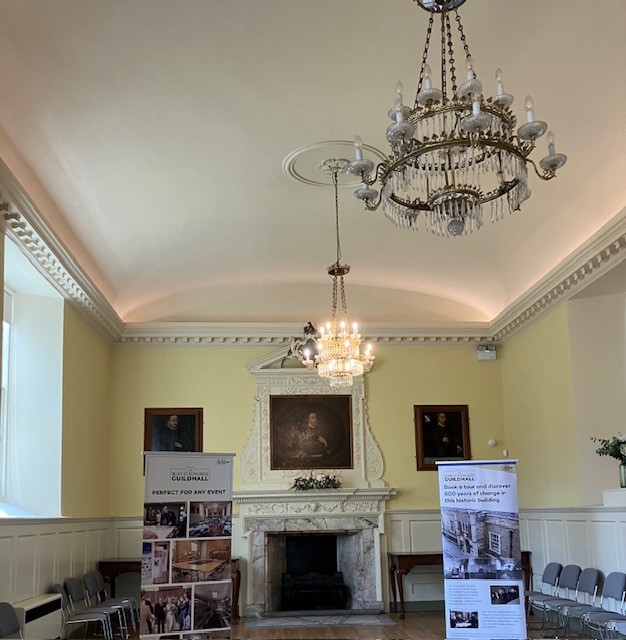
In 1768, the Guildhall was divided into two rooms, the Court Room and the banqueting hall.
The hall was used for entertaining and for debate. Anti-slavery Society meetings were held at the Guildhall in 1830 which was 3 years before slavery was abolished in the British Empire. Another interesting case was debated after a little girl had been gored: bull baiting was banned in Bury St Edmunds 20 years before it was banned nationally.
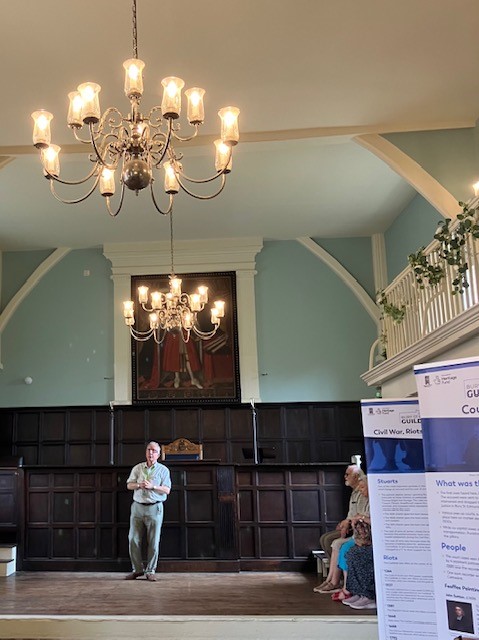
The courtroom was originally a pop-up court, one was called the court of Dusty Feet, which dealt with local cases such as coin-clipping and “riding furiously through the town”.
After the decline of the Abbey, the Trustees of the Guildhall, called Feoffees, became responsible for looking after the deserving poor and providing them with justice, food and healthcare. This powerful group of men used their wealth and influence to fight for the rights of the town’s poorer citizens. In 1637, 10% of the population died of the plague.
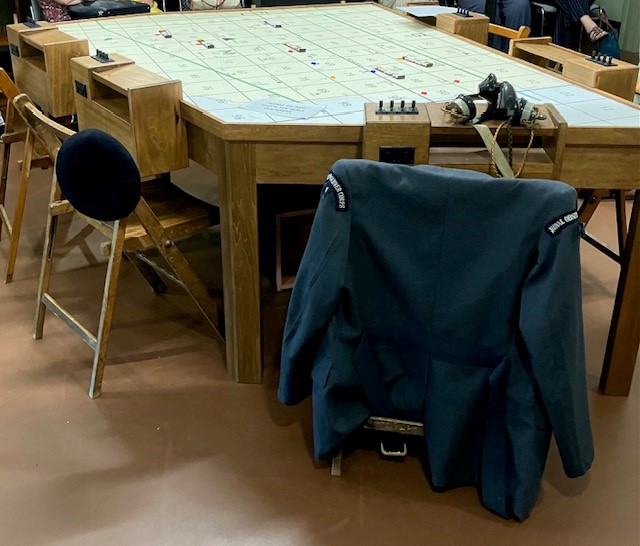
The Guildhall was also home to a group of remarkable, but unsung, local heroes, who helped change the course of the Second World War. In 1939 the Royal Observer Corps (ROC) Centre was set up in the Council Chamber. The ROC was a civil defence organisation which tracked aircraft movements above the skies of Britain. Their information was sent to RAF Fighter Command and helped to save thousands of lives. The Guildhall’s ROC Operations Room is the only surviving one of its kind in the world.
This last room in the Guildhall was a fascinating end to our Tour.
———-
Bury St Edmunds ancient GUILDHALL – a report from Joan.
Members travelled to Bury St Edmunds for a guided tour of the ancient Guildhall.
The earliest written mention of the Guildhall is in 1279, when the Bury St Edmunds Chronicle recorded the arrival of two visiting Lords. Recent archaeological discoveries suggest the building is much older, possibly dating to the early 1100s or even earlier.
It was built to host the local Guildhall Merchants, a group who oversaw all the business of the town, which was then at the heart of the lucrative wool trade. As a centre of civic power, the Guildhall became a bitter rival of the powerful Abbey of St Edmund and was a focal point for the town’s own peasants’ revolt in the 1300s – when a group of monks were held hostage within its secure walls.
The great and the good who ran the Guildhall used their wealth and influence to fight for the rights of the town’s ordinary citizens. They delivered justice in the Courtroom, turned the Tudor Kitchen into a soup kitchen in times of need, and offered the Banqueting Hall as a meeting space for the most important discussions of the day – including the fight to abolish the slave trade.
The Guildhall sits on land that originally belonged to the abbey and was given, by Abbot Ording, to host the local Guild of Merchants. Initially the Guildhall was built as a long, rectangular building 38 metres long, with small thin windows, a thatched roof and doors in line with each other at the front and back of the building.
In 1768, the Guildhall was divided into the two rooms you see today, the Court Room and the Banqueting Hall.
The Guildhall was also home to a group of remarkable, but unsung, local heroes, who helped change the course of the Second World War. The Royal Observer Corps (ROC) was a civil defence organisation which tracked aircraft movements above the skies of Britain. Their information was sent to RAF Fighter Command and helped to save thousands of lives. The Guildhall’s ROC Operations Room is the only surviving one of its kind in the world – a small space with an incredible story to tell.
The photos below are from Clare.
The photos show:
Entrance from Guildhall Street
Banqueting Hall
Court Room
WW2 Royal Observer Corps Operations Room