

On 10th June, Anne Grimshaw gave us two excellent talks in her usual inimitable style: enlightening, informative and entertaining.
Anne started her first talk “History of the Co-Op, Making a Difference… since 1844” with a question: what links Long Melford Heritage Centre with the Co-Op ? The answer is a Co-Op grant. You can pay £1 to have one share in the Co-Op; amazingly this is the same amount as in 1844.
The Co-Op started in the middle of a depression, the “Hungry 1840s”. There was a potato famine in Europe and the industrial revolution caused a migration of people from rural areas to towns resulting in poverty, poor housing and high rents. Food was often adulterated by chalk being added to bread and sawdust bulking out oats.
In 1844, a group of working men, the Rochdale Pioneers, got together to sell honest food at honest prices. They each saved £1 to rent a building in Toad Lane, Rochdale, and opened their first shop in December 1844. They sold 5 food items: butter, flour, sugar, oatmeal and candles. They pushed the goods by wheelbarrow from Manchester market over the Pennines. For their shop, they drew up a list of 7 Co-operative principles based on the values of Robert Owen, a Welsh textile manufacturer, philanthropist and social reformer.
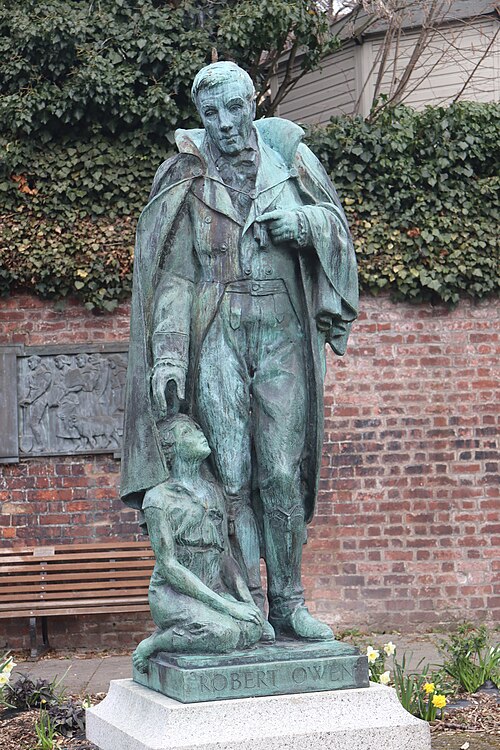
The Co-Op is owned by its members who have a say in how it is run. No credit was allowed to promote money management. Soon they had 74 members and 16 years later in 1860, they had 3,460 members. They bought 6 more stores and were able to buy in bulk to reduce prices. Each shop had a reading room where newspapers could be read out to raise literary standards. They organised speakers and looked after the welfare of employees. In 1907, they even set a minimum wage. Today there are around 17 million members.
On a local level today, the Co-Op in Long Melford has donated to the Long Melford Heritage Trust, which encourages youngsters to take an interest in history, join archaeological digs and bring the community together. Whenever you spend a pound at the Co-Op, you receive 2p and 2p goes to the local area to support the community. The pioneering, philanthropic spirit of the early Co-Op is still alive today.
Anne’s second talk was “The Saddest Sunday“.

.jpg)
Eric Friedebach, CC BY 2.0 https://creativecommons.org/licenses/by/2.0, via Wikimedia Commons
This talk was about the tragic story of a US B-17 bomber from Sudbury airfield that crash-landed on Sunday 15th October 1944. The crash site was near the current location of Sudbury’s Tesco store.
The sad events unfolded early on that morning. The Boeing B-17 Flying Fortress known as “Miss-B-Havin”, commanded by Second Lt. Clarence Hermann, took off from Sudbury on a bombing mission to Cologne, Germany. Shortly after take-off, the pilot had engine problems and the plane was struggling to gain height. Then there was a loud explosion and the plane crashed into part of the roof of nearby Woodhall farmhouse before continuing a short distance and exploding in a field beyond the house.
Major Smith lived with his family in Woodhall farmhouse. The explosion woke him and he managed to rescue his wife and 2 daughters. He went back into the house for his 15 year old son, Raymond. He had difficulty reaching Raymond as the stairs to Raymond’s bedroom were blocked with debris and there was a fire burning on the floor above. Raymond climbed down through the debris and a USAAF jeep took him to the local hospital. Tragically, he suffered severe burns and damage to his lungs and this led to Raymond’s death.
Sadly, eight of the nine-man crew were killed, but happily the pilot was blown clear when the aircraft exploded. He was taken to the Station hospital at Acton where he spent two months recovering. He was flown back to the States, where he eventually made a full recovery, contrary to subsequent reports.
This tragic event has recently been commemorated on its 80th Anniversary with a service attended by the British Legion, the Sudbury Major and more poignantly, Raymond’s sister, Joyce Felton.
A plaque was unveiled on Tesco’s wall so that this Saddest Sunday will never be forgotten.
Both talks by Anne Grimshaw were meticulously researched and it was fascinating to learn about events on our doorstep.
Thank you for the information on the recent talk, however I never get any notification about when any upcoming talks are being scheduled. Is there a mailing list you can add me to in this regard?
Hi Mark, you should be able to see the 2026 programme at this link, but do let us know if you can’t view it – https://sudburyhistorysociety.co.uk/wp-admin/post.php?post=1651&action=edit
We’ll also be happy to give you a physical copy of the programme when you next attend a meeting, just ask when you sign in.